
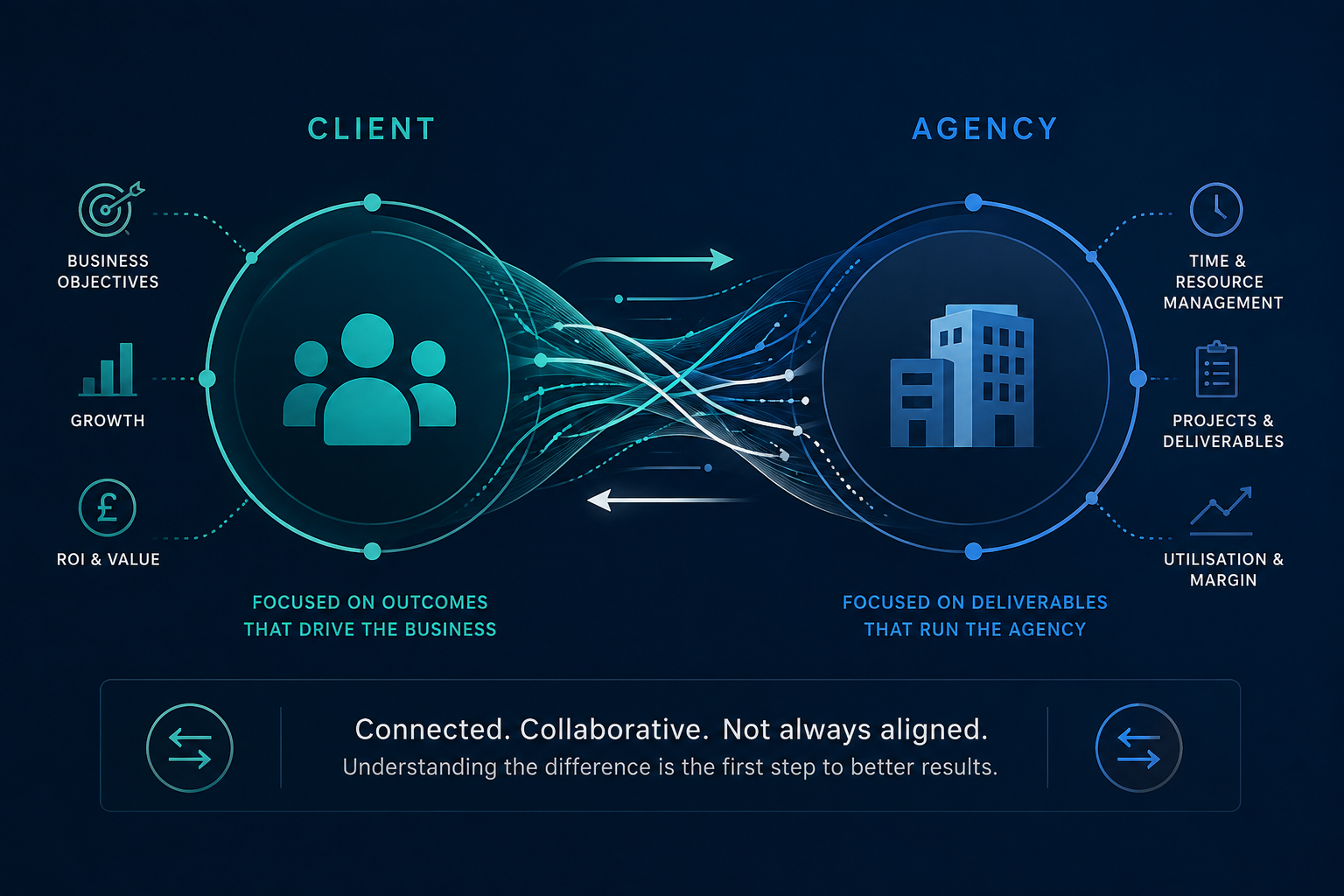
Marketing agencies and their clients usually want the same thing: good work that delivers results. But that doesn’t mean their priorities are always perfectly aligned.
An agency is also a business. It has people to utilise, margins to protect, scopes to manage and commitments across multiple clients. None of that is inherently problematic. But it can influence where time, attention and resource are directed — particularly as a client relationship matures.
For marketing leaders, understanding that dynamic can help explain why an agency relationship that appears perfectly healthy can still leave performance, efficiency or opportunity on the table.
The agency business model creates different pressures
Most agencies operate around a combination of retainers, agreed scopes, projects and allocated resource. To run profitably, they need to manage how their teams spend their time, keep people productively utilised and deliver work within the commercial parameters agreed with each client.
Those pressures can subtly shape behaviour. Work that fits neatly within the existing scope may be easier to prioritise than work that requires a different skillset, additional resource or a fundamental rethink of the original plan. Equally, an agency may naturally focus on the channels and services it provides rather than asking whether investment would now be better directed somewhere else.
None of this means the agency is doing a bad job. In many cases it is simply doing exactly what it was engaged to do. The question for the client is whether what the agency was originally engaged to do is still what the business needs most today.
Retainers can make that harder to see
Retainers are useful for both sides. They give clients predictable access to expertise and give agencies predictable revenue and the ability to plan resource. But they can also create a tendency for activity to continue because it forms part of the agreed programme rather than because it remains the best use of the marketing budget.
Over time, a retainer can become a list of things that get delivered each month: campaigns managed, reports produced, content created, meetings held and channels maintained. All of that activity may be completed successfully while the more important question receives less attention: is this still where we should be investing our time and money?
This becomes particularly important when circumstances change. Budgets move, new channels emerge, internal capability develops, commercial priorities shift and customer behaviour changes. A scope agreed twelve or eighteen months ago may still be delivered efficiently while no longer representing the best possible allocation of investment.
Good performance can hide missed opportunity
One of the easiest traps is to assume that an agency relationship only needs reviewing when something is clearly going wrong. Performance may be reasonable, campaigns may be delivering and the relationship itself may be good. But that doesn’t necessarily mean you are getting everything you could from your marketing investment.
For an SME, that might mean a significant proportion of the marketing budget continues to go into the same channels because they have historically worked, while other opportunities remain unexplored. In a larger organisation, the same issue can appear across several agencies, internal teams and budgets, with each part performing adequately but nobody taking a sufficiently broad view of how they work together.
The distinction is between asking “Is our agency doing a good job?” and “Is our overall marketing investment working as hard as it could?” Those are not quite the same question.
Incentives aren’t always perfectly aligned
Agencies make money by providing services. That sounds obvious, but it matters when assessing the advice you receive. An agency recommending more activity, additional resource or an expanded scope may genuinely believe that is the right course of action — while also benefiting commercially if you agree.
The reverse can be true too. An agency is unlikely to recommend moving budget away from an area it manages unless there is a compelling reason to do so. And if your agency specialises in particular channels or disciplines, its view of the opportunity will naturally be influenced by the expertise and services it has available.
Again, this isn’t about questioning an agency’s integrity. It’s about recognising that the client and the agency view the same marketing investment from different commercial perspectives. An independent view can help separate what the business needs from what the existing agency model is naturally structured to provide.
The answer isn’t necessarily to change agency
An independent review doesn’t have to end with a new agency pitch. In many cases, the existing agency may be perfectly capable of delivering what the business needs; the opportunity is to improve the relationship around it.
That could mean changing the scope, reallocating budget, setting clearer objectives, improving reporting, bringing some activity in-house or simply being more explicit about what success looks like. For an SME relying heavily on one external partner, relatively small changes to the brief or priorities can make a significant difference. For a larger organisation, the opportunity may be in clarifying responsibilities across several agencies and internal teams.
Sometimes a change of agency will be justified. But it should be the result of the review, not the assumption behind it. The objective is better marketing performance, not agency change for its own sake.
What should you actually review?
You don’t need to wait for performance to deteriorate before asking some straightforward questions about the relationship:
- Objectives: Is the agency focused on the commercial outcomes that matter to the business, or primarily on channel and campaign metrics?
- Investment: Is budget still going to the right places, or has the allocation simply continued because that’s how it has always been structured?
- Scope: Does the current scope reflect what the business needs today?
- Performance: Are you getting a clear view of what is working, what isn’t and why?
- Resource: Do you know who is actually working on your account and where their time is being spent?
- Expertise: Are you getting the right specialist input when you need it, rather than only the capabilities already included in the retainer?
- Ways of working: Are your agency and internal team complementing each other, or are there gaps, overlaps or unnecessary dependencies?
- Challenge: Is the agency prepared to challenge your thinking — and are you giving them enough freedom to do so?
None of those questions requires a large marketing team or a six-figure agency budget. In fact, when resources are limited, understanding whether every part of your marketing investment is earning its place can be even more important.
A good agency review isn’t about finding reasons to change your agency. It’s about making sure your marketing investment is structured around what your business needs now.
When is it worth getting an independent view?
You don’t need to review your agency relationships constantly. But there are natural points when stepping outside the day-to-day relationship can be valuable: when performance has plateaued, budgets are increasing, a contract is approaching renewal, you’re considering a pitch, your internal team has changed, or you simply haven’t challenged the existing model for some time.
An independent review can provide a fresh perspective without the vested interest of either the incumbent agency or an agency hoping to replace them. The aim should be simple: understand what’s working, identify what could work better and make sure your marketing investment is focused on the opportunities that matter most to your business.
If you’d like an independent view of your current agency setup, you can find out more about my Agency & Marketing Audit service.